Key takeaways
- Agri drone work is a specialisation built around spraying, mapping and farm service.
- Commercial work with drones above the nano and micro classes needs a Remote Pilot Certificate.
- Our 5-day Agriculture Drone Operations course ends with a live spraying run.
- A Medium RPC plus Agriculture combo bundles both in one enrolment.
A specialisation after the basics
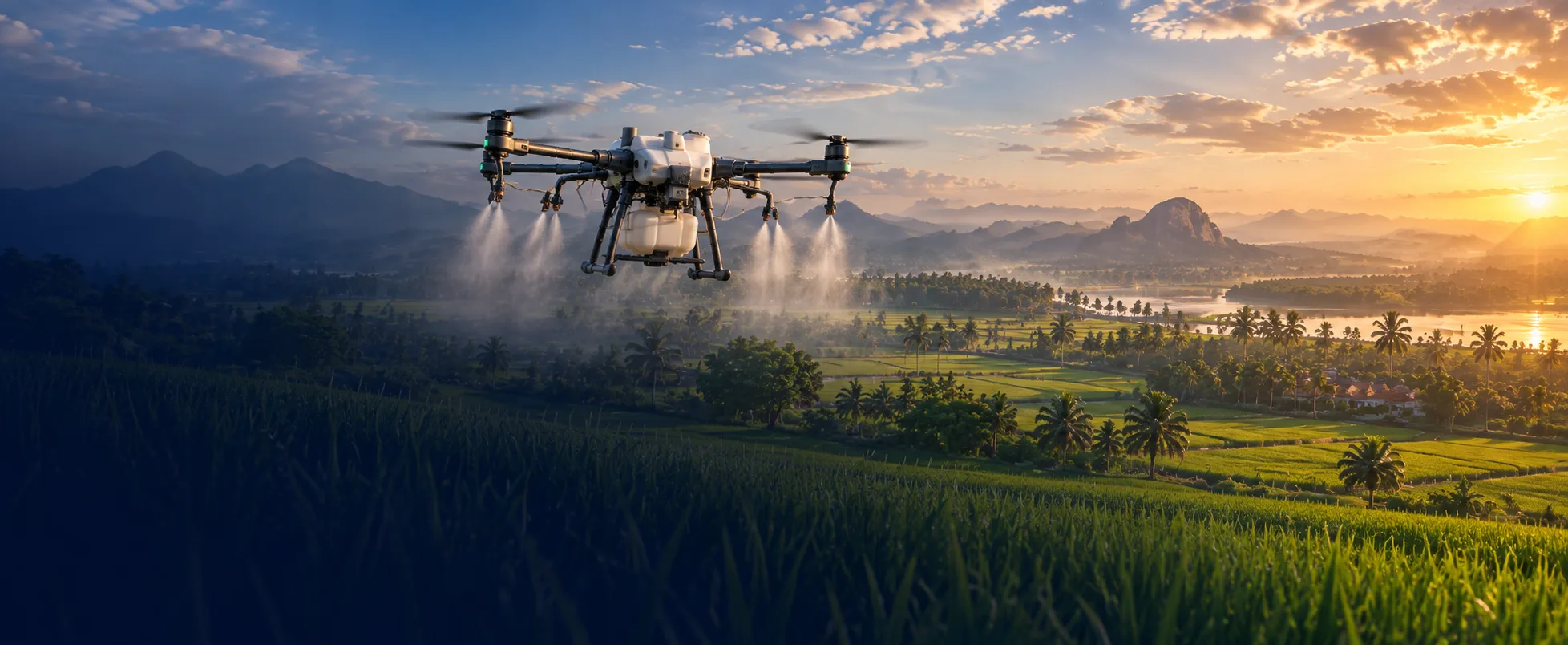
Agri drone work is a specialisation path around spraying, crop imaging and smart farming workflows. It rewards pilots who combine flying skill with practical farm knowledge.
What an agri drone pilot actually does
- Plans automated spray paths over a plot from its boundary
- Calibrates flow rate and dosage and chooses nozzles and pressure
- Flies the spraying mission, including battery and payload swaps
- Keeps spray logs, flight logs and compliance records for each job
Certification: where the DGCA fits in
Spray drones are heavy, usually well above the 2 kg micro limit, and they work commercially. That means a DGCA Remote Pilot Certificate is needed. Many agri platforms sit in the small class (up to 25 kg), while heavier ones fall in the medium class (25 kg to 150 kg).
Start with a Small Class RPC or Medium Class RPC depending on the aircraft you expect to fly.
RelatedSmall Class RPC training →Medium Class RPC training →
Our Agriculture Drone Operations course
This is a 5-day course (₹11,856 + GST (₹13,990 incl.)) with theory online and practicals on campus. Day 1 covers agricultural drones and DGCA guidelines, Day 2 mission planning and field mapping, Day 3 spraying system setup and calibration, Day 4 live field flying, and Day 5 assessment, documentation and certification. Eligibility is age 18 or above and 10th pass.
On completion you receive an Aerobot Labs Certificate of Completion. It is not a DGCA certificate, so pair it with your RPC.
The combo route
The Medium RPC + Agriculture Operations Combo bundles the Medium Class RPC with the agriculture course in one enrolment, at ₹25,839 + GST (₹30,490 incl.).
Skills worth bringing
- Knowledge of crops, plot layouts and local farming calendars
- Comfort with phones, maps and simple planning software
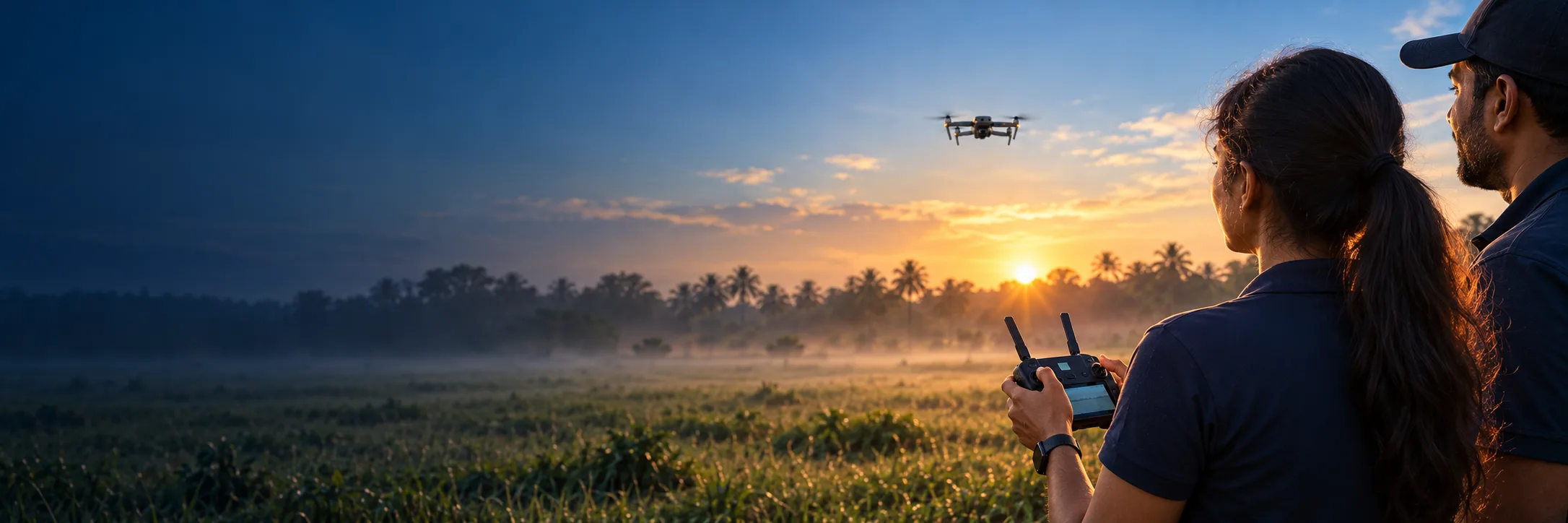
- Willingness to work early mornings in rural settings
- Careful handling of batteries, liquids and payloads
How to get started
Learn the rules through the free theory class, pick Small or Medium Class RPC for the aircraft you will fly, then add the agriculture course. Ask a counsellor about batch dates and the combo.
Working responsibly in rural areas
Spray work puts liquids and moving aircraft close to people, animals and water. Good operators brief landowners, check wind and weather, keep clear of houses and roads, and log every job. Our course teaches signal-loss and return-to-home procedure for exactly this reason.
Frequently asked questions
Do I need an RPC to operate an agri drone?
For commercial operation of drones above the nano and micro classes, yes. Check the current Drone Rules on Digital Sky.
Does the agri course give a DGCA certificate?
No. It gives an Aerobot Labs Certificate of Completion. The DGCA RPC comes from the Small or Medium Class course.
Who is the agri course for?
Farmers, agri-service contractors and technicians aged 18 or above with 10th pass.

Written by
Sakthivelan Ravindranath Tagore
Founder, Aerobot Labs
Aerobot Labs is a DGCA-approved RPTO in Chennai, training pilots, operators and drone engineers.